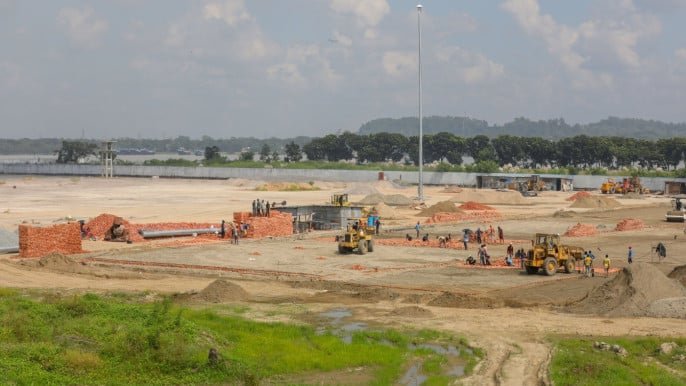
Exiting Chittagong Airport and moving along the main road, a large walled area appears on the right. Passing through the iron gate, one sees that the entire space is empty. This riverside area is fully covered with grass. There is a small room for security personnel. This was the scene observed on-site yesterday afternoon, Tuesday. The Laldia Container Terminal will be constructed on this vacant land along the banks of the Karnaphuli River.
To construct and operate the terminal on Laldia Char, the Chittagong Port Authority signed an agreement last Monday at a hotel in Dhaka with APM Terminals, a company under Denmark’s Maersk Group. The concession agreement with the Danish company is for 33 years for construction and operation of the terminal. If conditions are met, the company will have the option to operate it for an additional 15 years. QNS Container Services is involved as a local partner in the project.
When asked when the land will be handed over to APM Terminals, Chittagong Port Secretary Md Omar Faruk told Prothom Alo yesterday, Wednesday, “The agreement has just been signed. The next steps will now be taken according to the agreement.”
Sources associated with the agreement say that major construction work may begin in the second half of next year, after the land is handed over. Before that, several procedural steps need to be completed, including preparation and approval of the detailed project design. Typically, it takes three to four years to fully construct and operationalise a terminal.
APM Terminals is the second foreign company to join port operations in Bangladesh. Earlier, in June last year, Saudi Arabia-based port operator Red Sea Gateway Terminal International (RSGTI) became involved in the operation of Chittagong’s Patenga Terminal. Meanwhile, the process to appoint an operator for the New Mooring Container Terminal is ongoing.
This project, under a public–private partnership (PPP), is being handed over to DP World of the United Arab Emirates (UAE). To evaluate the project’s tender, the port authority formed a seven-member committee and sent it to the Ministry of Shipping on 16 November for approval.
Amirul Haque, Managing Director of Sea Com Group, told Prothom Also that appointing two international operators will elevate Chittagong Port to international standards. Increasing the port’s capacity will stimulate foreign trade. However, if tariffs are increased gradually and reasonably rather than all at once, there will be no negative impact on business.
If the depth at the mouth of the Karnaphuli River is increased, APM Terminals, operated by Maersk Line, will be able to berth relatively larger ships by taking advantage of the tides. With the ability to berth large ships, Maersk Line could offer direct shipping services to Europe and America. Since most of the global apparel buyers are Maersk Line customers, this will create an opportunity for Bangladesh’s export sector to become more competitive internationally.
Former member of the Port Authority Md Zafar Alam
Laldia to become operational in 2030
Currently, Chittagong Port has four operational terminals. Three of these were opened after Bangladesh gained independence, while one was operational during the Pakistan era. Once Laldia is operational, it will become the fifth container terminal at Chittagong Port.
After signing the agreement on Monday, APM Terminals issued a notice on their website stating that the terminal will be operational in 2030. At that time, the annual container handling capacity is expected to increase by 800,000 TEUs (twenty-foot equivalent units). Official statements mention that the terminal will open in 2029.
According to Germany-based consulting firm Hamburg Port Consulting, the four existing container terminals at Chittagong Port currently have an annual handling capacity of 3.5 million TEUs. When Laldia Container Terminal opens in 2030, this capacity will increase by 0.8 million to a total of 4.3 million TEUs.
The APM Terminals notice states that the construction of Laldia Terminal will involve an investment of over 550 million USD. During construction, around 1,000 people will be employed, and once operational, the terminal will provide employment for 500 people.
At container terminals, containers are loaded onto and unloaded from ships and then stored in open yards. These operations require heavy and specialised machinery. Significant investment is needed for everything from jetty construction to equipment procurement.
Laldia to allow accommodation of large ships
Laldia Char is located on the right bank of the Karnaphuli River, just before Guptabank near the river’s mouth. Beyond Laldia Char, the river bends upstream, known as Guptabank. After Guptabank are the RSGTI Chittagong Terminal and, further upstream, the port’s three main terminals. Ships must navigate the river bends to reach these terminals, making nighttime berthing risky and preventing large ships from docking. Constructing a terminal on Laldiaa Char will eliminate these obstacles.
On-site observations show that ships will be able to sail directly from the sea to the jetty to be constructed on Laldia Char without navigating any bends. This will remove the risks associated with nighttime berthing. Additionally, the terminal will be able to accommodate larger ships than other terminals.
APM Terminals has stated that currently, the main terminals at Chittagong Port can berth ships with a container capacity of 2,800 TEUs. Once Laldia Terminal becomes operational, it will be able to accommodate ships with a capacity of 6,000 TEUs.
Appointing two international operators will elevate Chittagong Port to international standards. Increasing the port’s capacity will stimulate foreign trade. However, if tariffs are increased gradually and reasonably rather than all at once, there will be no negative impact on business.
Amirul Haque, Managing Director of Sea Com Group
Sees the light after 11 years
The Laldia Terminal construction project began in 2013. That year, the Economic Affairs Committee of the Cabinet approved a competitive process to appoint an operator for the project. After completing all procedures, in 2017, five foreign companies were shortlisted from six applicants to participate in the main tender. However, the process was canceled midway during the Awami League government’s tenure.
After the competitive operator selection process was canceled, the government decided to implement the project on a government-to-government (G2G) basis. In June 2021, a G2G agreement was signed between Bangladesh and the Government of Denmark. On 16 May 2023, Denmark’s APM Terminals expressed interest and submitted a proposal to construct the Laldia Terminal. In January 2024, the project was selected during a joint meeting between the two countries. After the interim government came into office, the project gained momentum, and on Monday, it finally came to fruition with the signing of the agreement.
Greater advantages at Laldia Char
In Bangladesh, 99 per cent of container transport takes place through Chittagong Port. Containers are handled using the port’s four terminals. All exports are transported in containers, and a significant portion of imports, from raw materials for industries to commercial goods, also arrives in containers. Due to the shortage of container terminals, Chittagong Port experiences congestion for most of the year. Port officials believe that constructing a new terminal will help address this shortfall.
When asked, former member of the Port Authority Md Zafar Alam told Prothom Alo that Laldia will offer more advantages compared to the other terminals. If the depth at the mouth of the Karnaphuli River is increased, APM Terminals, operated by Maersk Line, will be able to berth relatively larger ships by taking advantage of the tides. With the ability to berth large ships, Maersk Line could offer direct shipping services to Europe and America. Since most of the global apparel buyers are Maersk Line customers, this will create an opportunity for Bangladesh’s export sector to become more competitive internationally.











Comments are off for this post.